

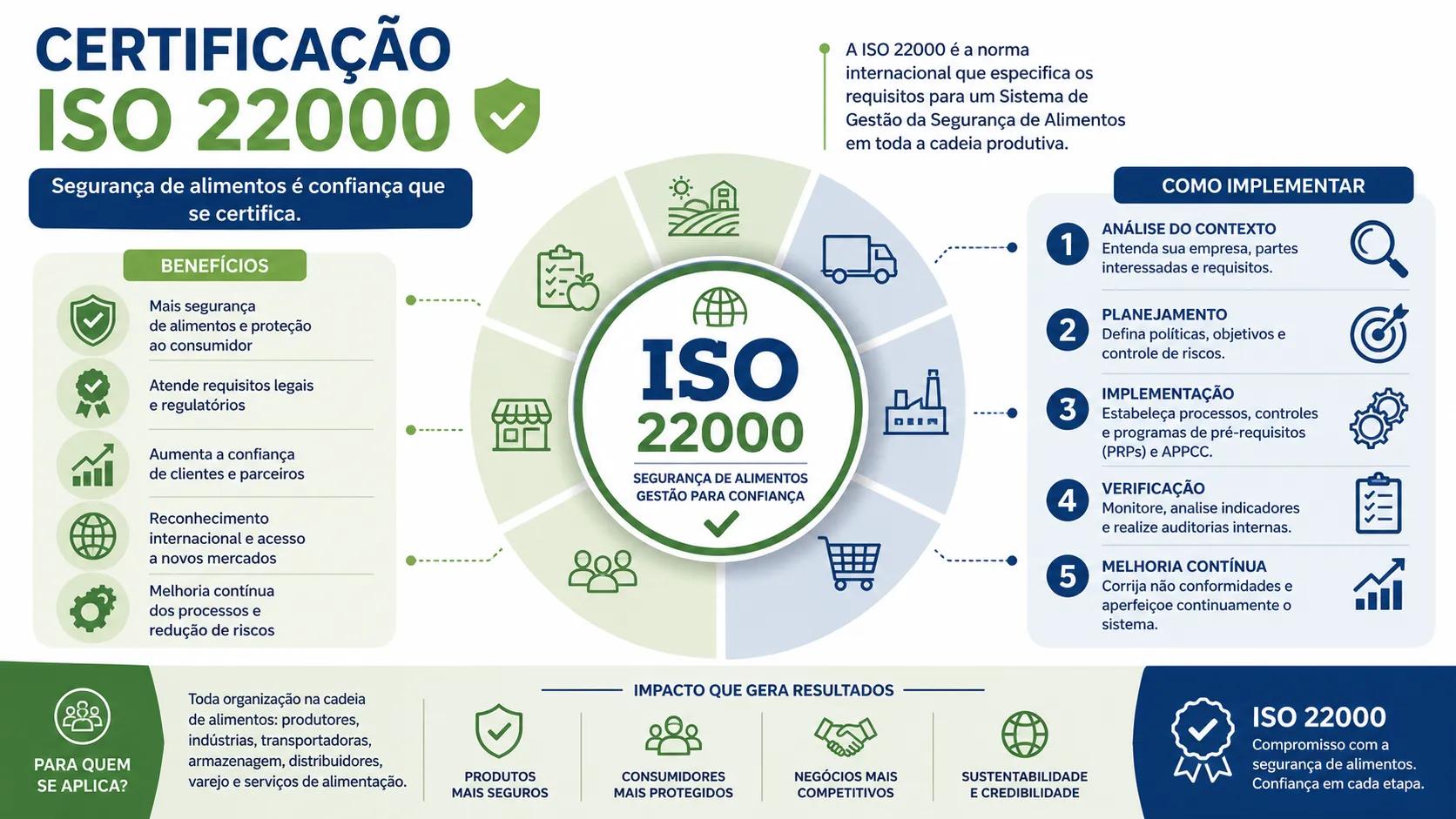
Certificação ISO 22000: A Complete Guide to Food Safety Management Systems
Certificação ISO 22000 is an internationally recognized standard designed to help organizations manage food safety risks throughout the food supply chain. From food manufacturers and processors to storage facilities, restaurants, catering companies, and distributors, ISO 22000 provides a structured framework for identifying hazards, controlling risks, and maintaining safe food practices.
Food safety is more than simply meeting legal requirements. Consumers expect food products to be safe, consistent, and produced under controlled conditions. A well-designed Food Safety Management System (FSMS) helps organizations meet these expectations while improving operational control and supporting continuous improvement.
What Is Certificação ISO 22000?
ISO 22000 is an international standard for Food Safety Management Systems. It combines key food safety principles, including hazard analysis, prerequisite programs, operational controls, communication, monitoring, and continual improvement.
The standard follows a systematic approach to managing food safety hazards. Organizations evaluate their processes, identify potential biological, chemical, and physical hazards, establish appropriate controls, and monitor whether those controls are working effectively.
ISO 22000 can be applied by organizations of different sizes and across different stages of the food chain. Its flexibility makes it useful for businesses involved directly or indirectly in food production.
Why Is ISO 22000 Important?
Food safety incidents can affect consumers, business operations, and an organization's reputation. A single uncontrolled hazard may lead to product recalls, customer complaints, regulatory action, or loss of market confidence.
ISO 22000 helps organizations take a preventive approach. Instead of responding only after a food safety problem occurs, businesses establish processes to identify risks before they become serious issues.
The standard also encourages communication throughout the food chain. Suppliers, manufacturers, transport providers, distributors, retailers, and other relevant parties can share important information about food safety risks and controls.
Key Elements of ISO 22000
An effective ISO 22000 Food Safety Management System includes several important components.
Hazard analysis is one of the central elements. Organizations identify potential hazards associated with raw materials, production processes, equipment, storage, transportation, and other activities.
Prerequisite programs (PRPs) establish basic hygienic and operational conditions. These may include cleaning and sanitation, pest control, personal hygiene, equipment maintenance, waste management, and appropriate storage practices.
Hazard control measures are established to prevent, eliminate, or reduce food safety hazards to acceptable levels. Depending on the process, organizations may use operational prerequisite programs and critical control points.
Monitoring and verification help confirm that food safety controls are functioning as intended. Records and documented evidence provide useful information for evaluating system performance.
Continual improvement ensures that the Food Safety Management System remains effective as processes, products, technologies, regulations, and customer expectations change.
Who Can Benefit From ISO 22000?
ISO 22000 is suitable for a wide range of organizations connected to the food chain. Food manufacturers and processors can use it to improve production controls and manage food safety hazards.
Other organizations that may benefit include:
Food packaging manufacturers
Storage and warehousing companies
Transportation and distribution providers
Catering organizations
Restaurants and food-service businesses
Retail and wholesale organizations
Ingredient suppliers
Agricultural and food-processing businesses
Cleaning and sanitation service providers
Equipment and material suppliers serving the food industry
The standard is not limited to large corporations. Smaller organizations can also establish systems that are appropriate to their size, activities, and operational complexity.
Steps Toward Certificação ISO 22000
Achieving certification normally begins with understanding the organization's existing food safety processes. A gap assessment can help identify areas that need improvement.
The organization then develops and implements its Food Safety Management System. This may involve establishing food safety policies, conducting hazard analysis, defining responsibilities, developing procedures, implementing PRPs, and maintaining appropriate records.
Employees also need to understand their responsibilities. Training and awareness are important because food safety controls depend heavily on consistent implementation at every operational level.
Once the system has been implemented and operated for an appropriate period, internal audits can be conducted to evaluate conformity and identify areas for improvement. Management review is another important activity because it allows leadership to evaluate system performance and determine necessary actions.
An independent certification body can then conduct an external audit. If the organization demonstrates conformity with the applicable requirements, ISO 22000 certification can be issued.
Benefits of ISO 22000 Certification
Implementing ISO 22000 can provide several practical benefits. One major advantage is improved control over food safety hazards. A structured system helps organizations identify risks systematically rather than relying only on informal practices.
The standard can also improve process consistency. Clearly defined procedures and responsibilities help employees understand what needs to be done and when.
Other potential benefits include improved supplier control, better documentation, stronger traceability, improved customer confidence, and greater preparedness for audits and regulatory requirements.
ISO 22000 can also support communication between different participants in the food supply chain. When organizations use a recognized framework for food safety management, sharing relevant safety information becomes more structured.
ISO 22000 and Continual Improvement
Certification should not be viewed as a one-time achievement. Food safety management requires ongoing attention.
Organizations should regularly review their hazards, monitoring results, audit findings, customer feedback, incidents, corrective actions, and changes in operations. These activities provide valuable information for improving the system.
Continual improvement also helps organizations respond to new food safety challenges. Changes in ingredients, suppliers, equipment, production methods, technology, or regulations may introduce new risks. A functioning FSMS provides a framework for reviewing these changes and implementing appropriate controls.
Conclusion
Certificação ISO 22000 provides organizations with a structured approach to managing food safety throughout the supply chain. By combining hazard analysis, prerequisite programs, operational controls, monitoring, communication, documentation, and continual improvement, the standard helps businesses create stronger and more consistent food safety practices.
For organizations working with food products or supporting the food industry, ISO 22000 can provide a practical framework for controlling risks and demonstrating a systematic commitment to food safety. More importantly, effective implementation helps make food safety part of everyday operations rather than treating it as a separate activity.